Today I am starting a series on leadership behaviours that help in contexts of uncertainty and accelerated change — and ones that don’t.
Deloitte’s 2026 Global Human Capital Trends report indicates that one third of workers experienced at least 15 major changes in the past year. These include changes in the work, in the skills required to do the work, in the tools used to do the work, and in customer expectations of the work. That’ll make your head spin! The report goes on to describe that the effects on workers have been largely negative, with 68% experiencing decreased wellbeing and 58% feeling less relevant or left behind. And leaders themselves aren’t immune to this pace of change — they are experiencing it even as they must lead through it.
The first things leaders need to do is notice. We can’t be oblivious to the existence and the effects of such frequent major changes on our people.
Major changes can result in a period of fog, including for even the most capable of leaders. (Many authors write about this — most notably Jim Collins in his new book What to Make of a Life.)
What do we know about driving in fog?
I remember from my driver’s ed training 40 years ago that in foggy conditions, we are tempted to put on our high beams to see farther ahead, but they don’t help. We need to keep our regular headlights on and respond to the conditions immediately ahead of us. We drive at the pace that the next section of road appears.
Slower than that, and we could be hit from behind. Faster than that, and we’re enveloped in it and can’t move anywhere safely.
But what happens when the fog itself is caused by a need for greater speed? We can be tempted to drive too fast, in a panicky attempt to keep up.
It requires leaders to hold two polarities in a dynamic tension. One is the requirement to communicate steps forward that are small, safe and clear. The other is to remain innovative and responsive to an ever-changing context.
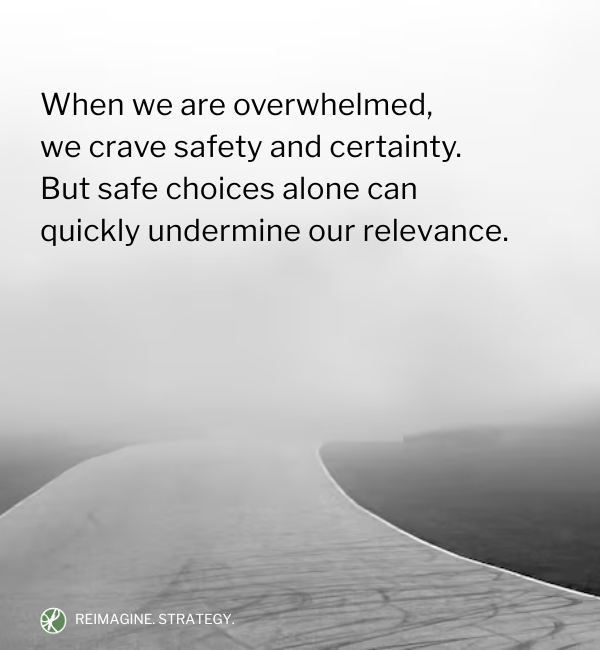
When we are overwhelmed, we crave safety and certainty. But safe choices alone can quickly undermine our relevance.
What helps? Developing what Deloitte calls “changefulness” — a fluid capability that cultivates people’s “abilities to adapt, experiment, learn and evolve as a daily muscle embedded in work, not as a disruption.”
But how?
In my work with the AQai Adaptability Quotient assessment, I notice two specific things that help leaders exhale: one is having a clear, data-informed picture of what is actually happening, so they know what they’re dealing with. Not at a conceptual level, but personalized to their team. And the second is adopting approaches to adaptability that are tailored to that data. It’s like having a well-stocked toolbox, and adding to it the magic of knowing just what tool is needed in a given situation. We know we need to be adaptive, but AQ results help a team know which tools they prefer to use to get that job done.
But even without AQ data in-hand, there are lessons for any leader here:
- Your people, and you, are experiencing a lot of change.
- That’s not going to change. Change is not an exception and adaptability is not optional. This helps us set expectations and not panic.
- “Change management” initiatives are not the answer. They are too slow, and imply too much predictability and control.
- Instead, where you can, communicate safe, clear, small steps. Encourage your people to do the next right thing.
- In the meantime, develop adaptive skills so that your teams are confident they’ll be equipped to handle whatever comes around the next bend. Getting good at this is possible.
It’s a start…more next week.