I work with a lot of nonprofit Boards of Directors.
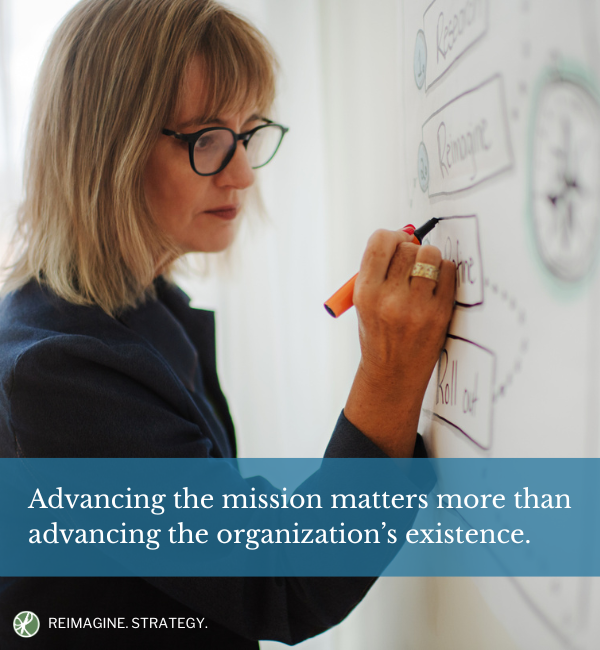
I’m noticing that the ones I enjoy the most are the Boards who understand their role primarily as advancing the organization’s mission more than advancing the organization’s existence.
This matters for three main reasons:
- These Boards are not over-indexing on organizational positioning or survival at the expense of performance.
- They understand performance differently, as impact more than income.
- They pull together the players needed to solve a problem at a system level rather than limiting conversations to their organization alone.
This idea does not only apply to Boards, of course. Where else might you be playing a game of protectionism that would be better played as advancing a collective mission?
And to take it one step further: why is this so hard?
I think the answer hinges on how leaders perceive their mandate. Directors govern organizations — yes. Yet although stewarding an organization’s future is a worthy task, ensuring its community-benefit mission is achieved is even more important. A Director’s role can reasonably be framed either way — why not choose the path of bigger impact?
Another obstacle is a need for confidentiality, real or perceived. It can feel threatening to pull back the curtain and let others in. But is it possible the reward is worth the risk?
The more practical part of the answer is the effort required. Most of us can barely muster the time and skills to run an effective planning session within our own organization, without the added complexity of inviting others to join us.
I get it. That’s where I can help. Designing and facilitating high stakes, complex, multi-organizational gatherings is what I love to do. Help is available.
Which is why I suspect the problem is more about mindset than mechanics.